
Why do two furniture suppliers receive the same product brief yet deliver completely different results? Most buyers start looking for answers after production begins. That’s understandable because defects become visible only when products start coming off the line. However, procurement teams that deal with global manufacturing know the real answer usually lies much earlier.
Many furniture quality problems occur when the supplier audits are on evaluation, product requirements are discussed, and production plans are still pending approval. If the manufacturing starts, then there is very little chance to correct these early decisions without affecting cost, lead time, and product inconsistency.
Where Quality Failures Actually Begin
Table of Contents
Most furniture quality problems don’t suddenly disappear on the production line. It is shaped by dozens of decisions that happen before the factory receives the purchase order.
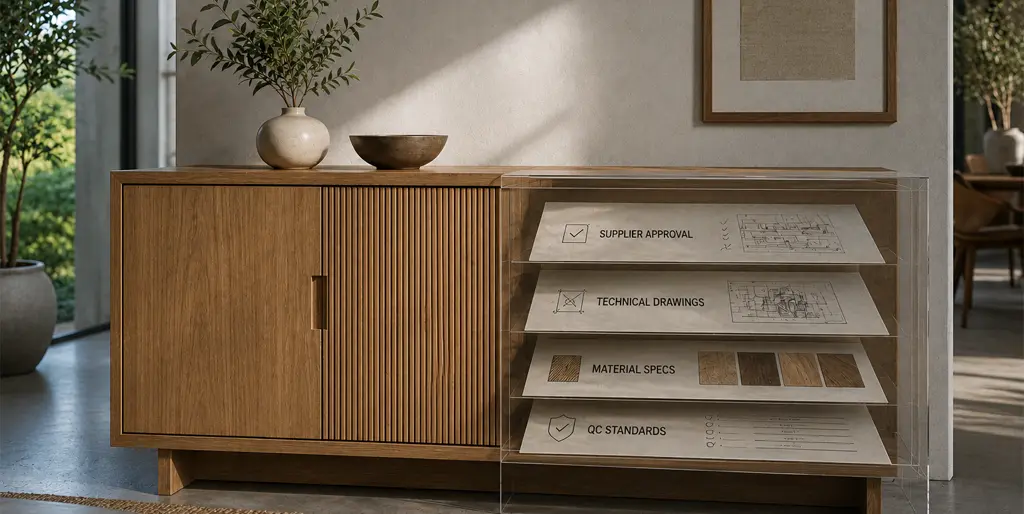
Supplier capability, technical documentation, material selection, approved samples, and production expectations all influence the final outcome. If one part of that preparation is weak, the factory spends production solving uncertainty instead of building consistency.
What the Supplier Audit Stage Really Tells You
A sample can demonstrate what a factory produced on a particular day. It cannot show whether the same standard can be maintained across every production batch.
That is why the supplier audit stage deserves more attention than many buyers give it. It provides an opportunity to understand how the factory operates before production begins.
An experienced audit looks at everyday working practices. How are incoming materials inspected? How are defects recorded? Who approves process changes? Are production procedures documented, or do they depend on individual experience? The answers reveal how the factory is likely to perform when production volumes increase. When furniture quality problems appear during production or final inspection, then factory become the point of discussion.
At Global Base, supplier audits are designed to answer these practical questions before production begins. Over the years, our procurement teams have found that understanding how a factory works on a normal production day provides far more reliable insight than evaluating a sample alone.
Clear Specifications Reduce Unnecessary Decisions
Factories depend on accurate information. When drawings, material requirements, packaging instructions, or finishing standards leave room for interpretation, production teams have to make decisions that should already have been made during procurement.
Different interpretations often lead to different results, even when the supplier has the right equipment and experienced workers.
Why the Factory Gets the Blame
Most quality concerns are discovered during manufacturing or final inspection, so it is natural for attention to shift towards the factory.
The difficulty is that production often exposes a problem instead of creating it. If supplier expectations were never fully aligned or product requirements changed during the project, the factory can only work with the information it has received.
Vendor Compliance Monitoring Keeps Standards Consistent
Approving a supplier is only the beginning of the relationship. Production teams change, raw material sources change, and manufacturing priorities also change over time. Without regular vendor compliance monitoring, small differences can gradually appear from one production run to the next.
Monitoring those changes early allows procurement teams to resolve issues before they become customer complaints or rejected shipments.
This is why Global Base continues working with suppliers after approval instead of treating factory evaluation as a one-time activity. Regular production reviews and supplier communication help maintain consistency across repeat orders rather than relying only on final inspections.
Top 3 Procurement Decisions That Create Quality Risk
Most furniture quality problems can be prevented before production. The challenge is that the decisions responsible for them often appear routine when they are being made. A supplier is approved, a sample is signed off, and production is scheduled. Weeks later, when defects begin appearing; those early decisions are rarely questioned. In reality, they deserve the closest attention.
Choosing a Supplier Before Understanding Their Capability
When a business chooses the supplier selection, then price, lead time, and production capacity are covered in that point of conversation.
Price, lead time, and production capacity usually receive immediate attention during supplier selection. They matter, but they don’t tell the full story. A supplier may have the equipment to manufacture a product, yet struggle to maintain the same standard across larger production volumes.
That is where quality control should begin. It should be built into the procurement process through factory assessments, sample reviews, production checkpoints, and clear reporting instead of being left until the final inspection.
Approving Samples Without Confirming Production Consistency
A well-finished sample gives confidence, but it doesn’t guarantee that every unit leaving the factory will match it. Production conditions change. Different operators may work on different batches.
Raw materials may come from another supplier. Unless consistency is checked throughout manufacturing, the approved sample gradually becomes a reference instead of a standard. That is why experienced procurement teams continue monitoring production after approvals rather than assuming everything will remain the same.
How to Catch Quality Risks Before Manufacturing Starts
Furniture quality problems are rarely created by one mistake. They usually develop through a series of procurement decisions made before manufacturing begins.
By the time a shipment fails inspection, the cost is rarely limited to replacing defective products. Delivery schedules change, retail launches are delayed, and relationships with customers become more difficult to protect. Reducing that risk starts before manufacturing begins.
Build Quality Into Every Procurement Decision
Strong procurement teams don’t rely on a single inspection to protect product quality. They create checkpoints throughout the sourcing process. Supplier audits confirm capability. Product specifications remove uncertainty.
Production reviews identify issues before they spread across an entire order. Regular communication keeps suppliers aligned with agreed standards instead of allowing small changes to become larger problems. This approach reduces rework because potential issues are identified while they are still easy to correct.
Conclusion
The quality of furniture is rarely decided on the production line alone. It starts before production at the time of supplier selection, technical planning, and factory assessments. In this way, quality teams ensure the product quality before the production begins.
The businesses that consistently receive quality products follow these principles. They keep their eye on quality control rather than an inspection after the production. That’s why well-defined procurement programs are important for supplier evaluation, production visibility, or ongoing oversight of production activities.
At Global Base, our procurement is designed to reduce the furniture quality problems. We have combined supplier audits, production monitoring, and structured procurement processes; quality is managed from the beginning of the manufacturing journey rather than being left to the final inspection stage after the production.
Frequently Asked Questions
1. What causes furniture quality problems before manufacturing starts?
Most furniture quality problems begin during supplier selection, product specification, sample approval, and production planning. Weak decisions at these stages often lead to defects that become visible only after manufacturing begins.
2. Why is the supplier audit stage important for furniture procurement?
The supplier audit stage helps buyers evaluate factory processes, material controls, production capability, and quality systems before placing an order, reducing the risk of inconsistent product quality later.
3. Can quality control alone prevent furniture defects?
Quality control is important, but it cannot correct poor supplier selection or unclear specifications. Preventing quality issues requires strong procurement planning before production starts.
4. What is vendor compliance monitoring?
Vendor compliance monitoring checks whether approved suppliers continue following agreed quality standards, production processes, and material requirements throughout the manufacturing relationship, not just during the first order.
5. How do procurement programs improve furniture quality?
Well-structured procurement programs combine supplier audits, production monitoring, quality checkpoints, and supplier performance reviews to identify risks early and improve consistency across every production cycle.